





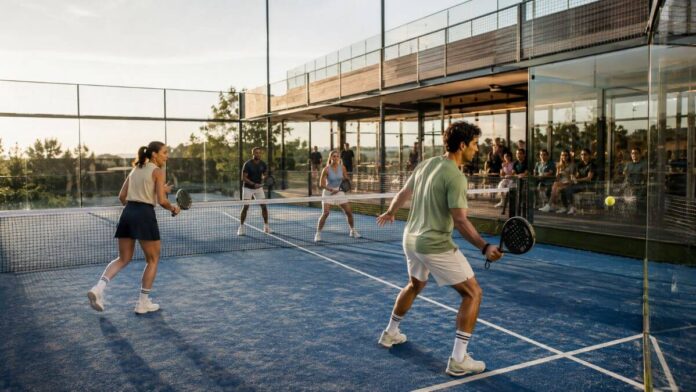
At first glance, padel can look like fast-paced tennis compressed into a glass box. There is a net, a familiar-looking ball and four players holding rackets. Then the first rally begins.
The serve comes underarm. A shot passes a defender, rebounds from the back wall and returns to the point. Partners move forwards and backwards together. A ball that looked impossible to retrieve suddenly creates another attacking opportunity.
That combination helps explain why padel has grown so quickly. It gives beginners a relatively accessible route into a racket sport, places social interaction at the centre of the game and still offers considerable technical and tactical depth.
Padel is popular not because it is effortless, but because new players can become involved quickly while experienced players continue discovering harder problems to solve.
Its growth is now global. In June 2026, the International Padel Federation reported 38 million players across 178 countries and territories, supported by approximately 85,000 courts and 27,000 clubs.
Quick Answer: What Is Padel?
Padel is a fun racket sport normally played in doubles on an enclosed court measuring 20 metres by 10 metres. Players serve underarm, use broadly the same scoring system as tennis and can return the ball after it rebounds from the glass walls on their side of the court.
It is popular because the basic rules and strokes can be introduced relatively quickly, the doubles format makes it naturally social, and the walls help create longer, less predictable rallies. As players improve, padel becomes increasingly tactical, with positioning, patience, partner communication and control often mattering more than raw power.
| Question | Answer |
| How many people play? | Usually four, in doubles |
| How large is the court? | 20 metres by 10 metres |
| How is the ball served? | Underarm after being bounced |
| How does scoring work? | Broadly the same as tennis |
| Can the walls be used? | Yes, once the ball has bounced correctly |
| What equipment is needed? | Padel racket, padel balls and suitable shoes |
| Is it suitable for beginners? | Yes, particularly with introductory coaching |
| Is it easy? | Accessible to begin, difficult to master |
Where Did Padel Come From?
Padel was created in Acapulco, Mexico, in 1969.
Enrique Corcuera wanted a tennis court at his home but did not have enough room for a full-size one. He instead created a smaller 20-by-10-metre court enclosed by walls, with a tennis net through the centre. That became the first padel court.
The sport later developed particularly strongly in Spain and Argentina before expanding across Europe, the Middle East and other international markets.
Its origins also help explain why the walls are not an optional novelty. They were part of the original court and remain central to how padel is played.
How Is Padel Played?
The Court
A regulation padel court is enclosed by glass walls and metal fencing, with a net separating the two halves. It is smaller than a tennis court: a doubles padel court measures 20 metres by 10 metres, compared with 23.77 metres by 10.97 metres for a tennis court.
The enclosure is the most obvious visual difference from tennis, but it also changes the sport tactically. The glass is part of the playable area rather than simply the edge of the court.
Doubles
Padel is predominantly played by four people in doubles. Singles courts exist (you need higher level of fitness and a lot of strategy), but most courts and competitive formats are designed for two pairs.
That doubles structure matters. From the first point, players must communicate, cover space together and make decisions based on where their partner is standing.
Serve and Scoring
A point begins with an underarm serve. The server bounces the ball behind the service line, strikes it below waist height and sends it diagonally into the opponent’s service box.
Scoring follows the familiar tennis sequence of 15, 30, 40 and game, with matches commonly played as the best of three sets.
The underarm serve removes one of the more technically difficult entry points found in tennis. A beginner can start a rally without first developing a consistent overhead service action.
Using the Walls
During a rally, the ball must normally bounce in the receiving court before touching the wall or fencing. Once it has bounced on your side, you may allow it to rebound from the glass before returning it.
This is one of the hardest adjustments for beginners. Many new players rush towards the ball and try to strike it before it reaches the wall. Others stand too close to the glass and leave themselves no space to react.
The better approach is often to move away, prepare early and read the rebound. LTA beginner guidance recommends creating space, reducing the size of the backswing and prioritising control over power.
Rackets and Balls
A padel racket has a solid face perforated with holes rather than strings. It is shorter and thicker than a tennis racket and is usually secured to the player’s wrist with a safety cord.
Padel balls look similar to tennis balls but are slightly smaller and less pressurised. They therefore move and rebound differently, particularly when they interact with the glass.

What Does Padel Actually Feel Like to Play?
Padel feels compact, collaborative and slightly unpredictable. And it’s great excercise.
The four players remain physically close to the action. Exchanges at the net can become fast, but points may also slow down as teams use lobs and the glass to recover their position. A shot that appears to have passed a defender is not necessarily a winner because the wall may return it to them.
This creates a distinctive rhythm. Players move between two broad positions: defending near the back of the court and attacking together near the net. One partner moving forwards alone can leave a large gap; one remaining behind can weaken the attacking pair.
It also creates a different emotional experience from a racquet sport in which errors repeatedly end the action. The enclosure gives players more chances to recover, improvise and stay involved.
The most satisfying beginner moment is often not a powerful smash. It is the first time someone calmly lets the ball reach the back wall, reads the rebound and returns it over the net.
That is often when padel stops feeling like unusual tennis and starts feeling like its own sport.
Why Is Padel So Popular?
-
Beginners Can Contribute Quickly
Padel has a low initial barrier compared with many racket sports.
The serve is underarm, the racket is short and relatively easy to control, and the court is compact. Because the game is played in doubles, each person covers less space than they would in singles.
LTA Padel says complete newcomers do not need previous tennis or racket-sport experience and can begin enjoying rallies relatively quickly.
This does not mean beginners immediately play well. New players still need to learn:
- Where to stand
- How to move with a partner
- When to approach the net
- How to use the walls
- How to control the ball
- Which shots not to attempt
The distinction is important: padel is beginner-friendly, not technically shallow.
A first-timer may contribute to a social game within one session. Mastering glass defence, net control, lobs, positioning and advanced overheads can take years.
-
It Is Social by Design
Many sports can be social. Padel makes social interaction part of the playing format.
Four people share a small court. Partners communicate constantly, and players are close enough to talk between points. Larger groups can rotate partners and opponents through short matches, Americanos and other mix-in formats.
LTA Padel highlights rotating social competitions as one of the sport’s strengths because participants can play both with and against different people rather than remaining in one fixed pairing.
The social structure continues away from the court. Clubs can organise:
- Beginner sessions
- Social mix-ins
- Group coaching
- Leagues
- Friendly tournaments
- Inter-club matches
- Family sessions
- Corporate events
This gives a new player several ways to become part of a community without immediately entering serious competition.
-
The Walls Keep Points Alive
The glass makes padel distinctive and helps create its sense of possibility.
A player can recover after being passed. A defensive shot can rebound into a better position. A rally can change direction suddenly without leaving the relatively compact court.
The walls do not guarantee long rallies, particularly at a higher standard. Strong players can finish points decisively. But for social players, the enclosure often provides more opportunities to return the ball and remain involved.
It also creates visible, shareable moments: unusual recoveries, rebounds, angles and escapes that look dramatic even to people who do not fully understand the tactics.
-
It Rewards Control More Than Brute Force
One of the most common beginner mistakes is trying to hit every ball hard.
Padel often rewards the opposite approach:
- Compact swings
- Accurate placement
- Patient defence
- Controlled lobs
- Moving as a pair
- Holding the net
- Reading rebounds
- Waiting for the right attacking ball
LTA coaching guidance describes padel as a game of consistency and advises players to use short backswings, accuracy and control rather than relying on power.
This helps broaden the game’s appeal. Strength and speed remain useful, but they do not determine every point. A patient, well-positioned player can frustrate someone who hits harder but makes poorer decisions.
That tactical balance also keeps experienced players interested. Once the novelty wears off, the sport reveals deeper questions about space, angles, anticipation and teamwork.
-
Different Ages and Standards Can Sometimes Share a Court
Padel can be a useful leveller, particularly in informal play.
The smaller court, underarm serve and doubles format can reduce some of the advantages associated with reach, serving power and long-distance court coverage. Level differences still matter, but organisers can use coaching, rotations and handicaps to make mixed sessions more inclusive.
One LTA case study follows the Fyfe family in Sheffield, where three generations—including a 75-year-old grandfather—play together several times a week. Their experience illustrates how the format can accommodate a broader age range within the same family activity.
The important qualification is that “suitable for everyone” should not mean placing complete beginners into a serious advanced match. Good level matching remains essential.
-
It Is Easy to Organise for Friends and Groups
Padel works efficiently as a group activity.
Four people fill one court. Eight can use two courts or rotate. Twelve or sixteen can play a structured tournament across several courts.
Partners can remain fixed for a competitive format or change every round to help the group mix. Sessions can be timed, allowing an organiser to know approximately when the sporting activity will finish and lunch or evening plans can begin.
That makes padel suitable for:
- Friendship groups
- Couples
- Families
- Corporate teams
- Club tours
- Birthday weekends
- Stag and hen trips
- Active holidays
Unlike a sport that occupies most of the day, padel can be scheduled as one defined part of a wider experience.
-
It Creates Community Beyond the Match
People often return because they find other people to play with.
Clubs and venues increasingly provide coaching groups, social sessions, ladders and local competitions. LTA Padel also points new players towards community groups where people arrange games with others at a similar standard.
A public example from Bristol shows how powerful that community can become. Seun and Laura Crowe began playing after Seun, who had no previous racket-sport experience, tried padel with her partner. Within 18 months, the sport had become a near-daily part of their lives and connected them to a wider local community.
Their experience also exposes an important limitation: as they moved into tournaments, they found that some events were not well matched to participants’ standards and involved too much waiting.
Popularity creates opportunity, but it also raises expectations around organisation, coaching and player experience.
-
It Fits Modern Club, Lifestyle and Travel Culture
Padel is easy to combine with other parts of the day.
A 60- or 90-minute session can sit alongside lunch, work, family time, a spa visit, a beach afternoon or sightseeing. This makes the game suitable not only for local clubs but also for resorts, hotels and short active breaks.
The sport has also developed a recognisable lifestyle around it:
- Contemporary clubs
- Social spaces
- Fashion-led sportswear
- Group coaching
- Amateur competitions
- Destination trips
- Wellness and resort packages
That wider culture undoubtedly helps visibility. But fashion and novelty alone do not explain repeat participation.
People may first notice padel because it looks modern and sociable. They continue playing because the game itself remains engaging.
Is Padel Easier Than Tennis?
Padel is often easier than tennis to begin playing socially. It is not simply an easier version of tennis.
| Feature | Padel | Tennis |
| Usual format | Doubles | Singles or doubles |
| Serve | Underarm | Usually overarm |
| Court | Enclosed, 20m × 10m | Open and larger |
| Walls | Part of play | Out of play |
| Racket | Solid and perforated | Strung |
| Beginner experience | Social rallies may develop relatively quickly | Consistent rallies can take longer |
| Advanced demands | Glass, positioning, net control and teamwork | Stroke production, serve, movement and court coverage |
Tennis experience can help with coordination, volleys and ball recognition. It can also create habits that need changing.
Tennis players often:
- Use swings that are too long
- Attack too many balls
- Stand too close to the baseline
- Treat the wall as an obstacle
- Move independently rather than with a partner
- Rely too heavily on power
Padel asks them to shorten their technique, use the glass and accept that keeping the point under control may be more valuable than trying to end it immediately.
How Is Padel Different from Squash and Pickleball?
Padel is sometimes described as a mixture of tennis and squash, but that description is only a starting point.
| Sport | Main distinction |
| Tennis | Larger open court, strung rackets and overarm serving |
| Squash | Opponents share an indoor court and strike directly against walls |
| Pickleball | Open court, different paddle and perforated plastic ball |
| Padel | Enclosed doubles court, net, glass walls and lower-pressure ball |
Pickleball does not use walls and can be played in singles or doubles. It uses a lightweight perforated plastic ball on a smaller open court.
Squash uses walls directly as target surfaces, whereas a normal padel shot must first cross the net and bounce correctly in the opponent’s court.
Padel has borrowed characteristics that may feel familiar, but its movement and tactics are distinct.
What Most Explanations of Padel Get Wrong
“Padel Is Easy”
Padel is easy to begin. It is not easy to master.
This distinction matters because describing the sport as effortless can undervalue coaching and frustrate new players when advanced skills do not develop immediately.
“It Is Just Mini Tennis”
The smaller court is only one difference.
The walls, underarm serve, shorter strokes, partner movement and emphasis on net position create a separate tactical game.
“Powerful Players Have the Biggest Advantage”
Power can win points, but uncontrolled power also creates errors and easy rebounds.
Placement, patience and court position are often more important.
“Any Four Standards Can Play Together”
Mixed standards can work socially, but only within limits. A complete beginner will struggle in an advanced match, while stronger players may become frustrated if every point is deliberately slowed down.
Level matching and thoughtful rotations protect the experience.
“The Growth Is Only Hype”
Padel has certainly benefited from fashion, celebrity interest and social media. But a purely fashionable activity does not usually produce 38 million players, 85,000 courts and 27,000 clubs across 178 countries and territories.
The lifestyle may attract attention. The game’s social format and depth help retain players.
What Are Padel’s Drawbacks?
Padel’s popularity should not obscure its limitations.
Court Access Can Still Be Uneven
Britain reached one million players in May 2026, using 1,825 courts across 551 venues. That represents rapid infrastructure growth, but demand and availability can still vary considerably by location and time.
Peak evening and weekend slots may be more difficult to obtain at busy venues.
It Can Be Expensive to Play Regularly
Court hire, equipment, coaching and membership vary by club. Because four players normally share a court, the individual cost may be manageable, but frequent play can still become a significant expense.
Poor Level Matching Can Damage the Experience
Beginners need enough support to participate. Stronger players need sessions that remain challenging.
A club that markets every activity as “all levels” without assessing participants risks disappointing both.
The Sport Is Physically Demanding
Padel may use a smaller court, but it still involves lateral movement, sudden stops, lunges, turning and overhead actions.
LTA guidance recommends a proper warm-up involving the shoulders, arms, thighs and calves before playing.
The Walls Take Time to Understand
Beginners may enjoy simple rallies quickly, but learning to defend consistently with the glass can take considerable practice.
That difficulty is not a flaw. It is part of what gives the sport lasting depth.
Why Is Padel Growing So Quickly in Britain?
Britain provides a clear example of padel’s acceleration.
The LTA reported one million adult and junior players by May 2026, up from 860,000 at the end of 2025, 400,000 in 2024, 129,000 in 2023 and only 15,000 in 2019. The country had 1,825 courts across 551 venues at the time of the million-player announcement.
Several factors are supporting that growth:
- New courts at tennis clubs, leisure centres and dedicated venues
- Greater public awareness
- Beginner coaching and social sessions
- A strong doubles culture
- Players discovering the sport abroad
- More leagues and competitions
- Easier digital court booking
- Growth of local playing communities
LTA research published in March 2026 also found that more than ten million Britons expressed an interest in trying padel.
The next challenge is converting that curiosity into sustainable participation. That requires sufficient courts, qualified coaches, appropriate competitions, safeguarding and an inclusive club culture.
Is Padel’s Popularity Likely to Last?
No sporting boom is guaranteed to continue indefinitely.
Padel’s long-term prospects nevertheless rest on more than novelty. The sport has several durable characteristics:
- A relatively accessible first experience
- A built-in social format
- Strong tactical depth
- Suitability for organised groups
- Coaching and competition pathways
- International court infrastructure
- Adaptability to clubs and resorts
Its risks are equally clear:
- Court shortages
- High prices
- Weak level matching
- Poor-quality coaching
- Overcrowded social sessions
- Exclusive club cultures
- Development without sustainable local communities
Padel’s future will depend less on how many people try it once than on whether venues make it easy for those people to play a second, fifth and fiftieth time.
The sport will last where curiosity becomes community.
How to Try Padel for the First Time
- Find a local beginner session or introductory clinic.
- Check whether the venue provides a racket and balls.
- Wear comfortable sports clothing and supportive trainers or court shoes.
- Book with players at a similar standard.
- Learn the serve, scoring and basic positions before worrying about advanced shots.
- Focus on keeping the ball in play rather than hitting hard.
- Give the glass time to make sense.
- Try several sessions before deciding whether the sport suits you.
LTA Padel offers a venue finder, coaching information and beginner guidance for players in Britain.
A beginner-friendly padel holiday can also provide a more immersive introduction, but the package should include appropriate coaching, level matching, equipment hire and enough recovery time.
Final Answer: Why Is Padel So Popular?
Padel is popular because it solves several problems at once.
It gives beginners a realistic way into a racket sport. It places four people inside the same shared experience. It creates rallies that feel dramatic without requiring every participant to have years of technical training.
Then, once the first novelty has passed, it reveals considerable depth.
The walls must be read. Partners must move together. Power must be controlled. Good players must understand when to defend, when to lob and when to take the net.
That is the real source of padel’s appeal:
The first session makes people feel involved. Every later session gives them something new to learn.
FAQs
What is padel?
Padel is a racket sport normally played in doubles on an enclosed 20-by-10-metre court. It uses an underarm serve, tennis-style scoring and glass walls that form part of the game.
Why is padel so popular?
Padel is relatively accessible for beginners, naturally social and easy to organise for groups. It also offers substantial tactical and technical depth as players improve.
Is padel easier than tennis?
Padel can be easier to begin playing socially because it has an underarm serve, smaller court and doubles format. It is not necessarily easier to master.
Do you need tennis experience to play padel?
No. Tennis experience can help with coordination, but padel has different strokes, positioning and wall play.
Is padel always played in doubles?
Padel is predominantly played in doubles. Singles courts exist, but the great majority of courts and professional play are designed around four players.
Can beginners use the glass walls?
Yes. The ball can rebound from the glass after bouncing correctly, although reading the rebound takes practice. Beginner coaching normally introduces wall play gradually.
Is padel physically demanding?
It can be. The sport involves lunges, side steps, rotation, short sprints and overhead shots. The intensity depends on the players’ level and the length of the session.
What equipment do you need?
You need a padel racket, padel balls and suitable footwear. Many venues rent rackets and provide balls.
Why is padel good for groups?
Its doubles format, compact court and rotating match formats make it easy to organise for friendship groups, families, clubs and work teams.
Is padel just a trend?
Its visibility may be influenced by fashion and social media, but its international playing base, court infrastructure, tactical depth and club communities suggest the sport has foundations for sustained participation.


