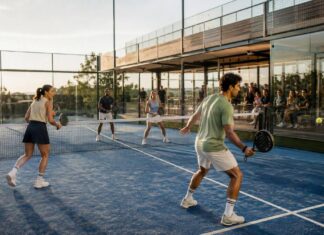


For decades, the golf weekend has provided a familiar formula for sporting travel. Choose a resort, arrange the rounds, add dinner and drinks, and let the sport give the trip its structure.
Padel is now creating another version of that fun weekend.
The sport combines friendly competition with a compact, social format that can sit comfortably beside beaches, restaurants, pools, spas and city plans. A group can play in the morning, meet for lunch, spend the afternoon exploring and return to the court later without organising the entire day around one activity.
Independent travel coverage has identified this crossover as a growing resort trend. Euronews reported in April 2026 that hotels and destinations were increasingly using padel as a travel draw, combining courts and coaching with luxury accommodation, social play and wider holiday experiences.
Padel is not replacing golf (just try suggesting that to golfing enthusiasts). Golf remains one of the world’s largest participation sport. The R&A reported that 112.2 million adults and juniors were playing across its markets outside the United States and Mexico in 2025, an increase of 4.2 million year on year. In the UK, it’s the biggest growing sport which padel courts replacing tennis courts around the country.
What padel is doing is widening the sporting-break market. It offers a different rhythm, one that works particularly well for mixed groups, shorter trips and travellers who want sport to enhance the getaway rather than consume it.
In short though, as someone who is not great at any racquet sport, padel is more inclusive for your beginner.
Quick Answer: Why Does Padel Work So Well for a Weekend Away?
Padel is predominantly played in doubles, is relatively straightforward to begin learning and allows players to rotate partners and opponents. Those characteristics make it well suited to friends, couples, clubs and larger groups with varied levels of experience.
| Feature | Traditional golf weekend | Padel weekend |
| Playing format | Players move around a course in smaller tee-time groups | Doubles matches on an enclosed court |
| Place in the itinerary | A round often anchors a substantial part of the day | Court bookings can be arranged as shorter activity blocks |
| Group organisation | Stable groups or pairings are common | Players can rotate through different pairs |
| Equipment | Clubs, balls, shoes and course clothing | Racket, suitable shoes and sportswear |
| Beginner involvement | Often easier with prior play or instruction | Basic rules and rallies can be introduced quickly |
| Wider holiday time | Frequently centred on the course and clubhouse | Easily combined with beach, pool, food and sightseeing |
| Best suited to | Travellers who want a course-led trip | Mixed groups wanting sport within a broader break |
| Atmosphere | Traditional, strategic and unhurried | Fast, collaborative and sociable |
These are common characteristics, not fixed rules. A short-format golf trip can be highly flexible, while an intensive padel camp can place training at the centre of nearly every day.
Padel Is Becoming a Travel Behaviour, Not Just a Growing Sport
The growth figures help explain why hotels and travel companies are taking padel seriously.
The International Padel Federation reported in June 2026 that padel had reached 38 million players across 178 countries and territories, supported by approximately 85,000 courts and 27,000 clubs.
Britain has followed the same trajectory. The LTA reported in May 2026 that the country had reached one million adult and junior players, with 1,825 courts across 551 venues. Participation had risen from 15,000 players in 2019 to 400,000 at the end of 2024 and 860,000 by the end of 2025.
Participation alone does not prove that everyone wants to travel for the sport. The stronger evidence lies in how hospitality businesses are responding: resorts are adding courts, coaching and padel-led programmes, while specialist operators package accommodation, organised matches, tournaments and transfers into group trips. Euronews has described padel holidays as part of the wider growth in active and sport-led travel.
That changes padel from something travellers happen to play while away into a reason to choose the destination in the first place.

Why Padel Works So Well for Groups
It Is Social by Design
Padel is normally played by four people. The court is compact, the rallies are shared and success depends heavily on communication between partners.
That makes the sport naturally suited to a weekend with friends or colleagues. Players spend the session interacting rather than competing in isolation, and changing partners can help a group mix more effectively.
For eight, twelve or sixteen travellers, a simple tournament can include:
- A short coaching introduction
- Round-robin doubles
- Rotating or fixed partners
- Semi-finals and a final
- A social lunch or evening afterwards
The LTA describes padel as a fast-paced, social doubles sport that is easy to start learning and open to players without a tennis background.
Mixed Standards Can Be Managed
Most group trips contain a range of personalities and abilities. Some travellers want serious competition; others mainly want to participate.
Padel allows organisers to manage that difference through:
- Separate introductory and advanced coaching
- Rotating stronger and newer partners
- Timed matches rather than long competitive sets
- Social mix-ins
- Scoring handicaps
- More than one court
- A coached warm-up before the tournament
The game remains tactically demanding for experienced players, but its entry point is relatively welcoming. That combination is valuable for a trip that must satisfy both regular players and first-timers.
It Gives the Group One Shared Centrepiece
A good sporting weekend needs a reason to exist.
Padel can provide that centrepiece without forcing the group into an intensive training schedule. The tournament, coaching session or club visit becomes the shared memory around which the wider trip is built.
That is particularly useful for:
- Friendship groups
- Club tours
- Corporate teams
- Birthday trips
- Stag and hen weekends
- Couples
- Families with older children
- Groups combining players and non-players
Padel Fits Around the Holiday
The defining advantage is not necessarily what happens on court. It is how easily padel leaves space for everything else.
An illustrative day might look like this:
09:30: Group coaching or tournament
11:30: Showers and coffee
13:00: Lunch
15:00: Beach, pool, spa or sightseeing
18:00: Optional social match
20:30: Dinner and evening plans
This schedule gives padel a clear presence without turning the break into a training camp.
Specialist group packages may combine hotel accommodation with court hire, organised match play, tournaments, equipment rental, optional coaching and airport or venue transfers. Dining, nightlife and additional activities can then be added according to the destination and group.
A padel weekend can therefore feel like:
- A city break with morning matches
- A beach holiday with coaching
- A resort stay with a social tournament
- A club tour
- A wellness weekend
- A celebration trip with an active daytime plan
The sport shapes the holiday, but it does not have to dominate it.

Padel and Golf Can Work on the Same Trip
The phrase “the new golf weekend” should not be interpreted as an either-or choice.
Some of the strongest sporting resorts now support both activities with padel facilities and superb golf links.
Grand Hyatt La Manga Club Golf & Spa combines three golf courses with a large racquets centre that includes several floodlit padel courts, coaching and equipment rental.
Pine Cliffs Resort in the Algarve has a nine-hole golf course alongside an academy with four padel courts, coaching and bookable matches and clinics. The resort also offers beach access, fitness and other activities.
That creates several possible group formats:
- Golfers play a morning round while other guests book padel.
- The full group meets for a padel tournament later.
- Beginners try padel while experienced golfers follow their own programme.
- Couples choose different sports before meeting for lunch.
- A corporate group alternates golf, padel and social events.
- A multi-generation family uses the resort’s broader facilities.
For hotels, padel expands the sporting offer. For travellers, it reduces the pressure for everyone to want exactly the same activity.
Why Padel Can Feel More Accessible
Less Equipment to Organise
Players can travel with one racket or rent equipment at the destination. Specialist group packages and resort academies commonly offer racket hire where required.
That can make a short flight or cabin-bag trip easier, particularly for beginners who do not own specialist equipment.
Short, Defined Sessions
Padel can be booked in clear court slots rather than as an open-ended daytime programme.
That means the sport can coexist with:
- A food tour
- A boat excursion
- A spa booking
- A city visit
- A beach afternoon
- A golf round
- A family activity
- Evening entertainment
The practical advantage is flexibility. The group can decide how central padel should be rather than accepting one standard holiday format.
Easy Rotation
Doubles courts make group rotation straightforward.
A group of sixteen could use four courts simultaneously, or fewer courts with players alternating between matches and social time. Fixed partners create a formal competition; changing partners makes the experience more inclusive.
The important planning variable is court capacity. A single court may work for four or eight people but lead to excessive waiting for a much larger party.
Who Is Choosing Padel Weekends?
Groups of Friends
Padel provides an organised daytime activity without requiring every evening or meal to be planned formally.
Club Players
Regular players may want coaching, match play against local opponents and warmer training conditions.
Corporate Groups
The doubles structure encourages communication and can work as a relatively accessible team activity when coaching and level matching are organised properly.
Couples
Two players can share lessons and matches. Where only one person plays, the destination should offer worthwhile alternatives such as a pool, beach, spa, golf or walkable town.
Celebration Groups
A tournament gives birthdays, reunions and stag or hen weekends a focal point that does not depend entirely on alcohol.
Beginners
New players can join introductory coaching and social games, provided the group or provider separates standards appropriately. “Suitable for all abilities” is only meaningful when beginners are not simply placed into advanced matches.
A Worked Weekend: Padel Versus Golf
The exact schedule will vary by resort and group, but the following illustrates the difference in rhythm.
| Example padel weekend | Example golf weekend | |
| Friday | Arrival and optional social hit | Arrival and practice range |
| Saturday morning | Coaching and doubles tournament | Main round |
| Saturday afternoon | Lunch, pool or sightseeing | Clubhouse lunch and free time |
| Sunday morning | Social matches with rotating partners | Second round or shorter format |
| Sunday afternoon | Beach, spa or departure | Lunch and departure |
| Equipment | Racket rental or one personal racket | Club hire or transported golf bag |
| Group structure | Regular partner rotation | Tee-time groups |
| Wider free time | Easy to preserve around court slots | Dependent on round and travel time |
This is an illustrative comparison, not an industry timetable. Padel can be scheduled intensively, and golf can be played in shorter formats.
The key difference is choice. Padel often makes it easier to decide whether the sport should occupy two hours, half a day or most of the trip.
Is a Padel Weekend Cheaper Than Golf?
Not necessarily.
Padel may involve less equipment and shorter sessions, but the final cost depends on the whole itinerary:
- Flights
- Accommodation
- Court or green fees
- Coaching
- Transfers
- Equipment hire
- Meals
- Resort facilities
- Number of nights
- Travel season
- Additional activities
A luxury padel resort with private coaching can cost more than a straightforward domestic golf weekend. A local hotel-and-court break may cost less than travelling abroad with clubs.
The only reliable comparison is the all-in cost of the complete trip.
When comparing padel packages, ask:
- How many court hours does each person receive?
- Are the sessions coached or self-managed?
- How many players share each booking?
- Are rackets and balls included?
- Are hotel-to-club transfers included?
- What board basis does the hotel offer?
- Are flights included?
- What happens if weather cancels a session?
A low headline price offers limited value if the courts are far from the hotel or the group receives very little playing time.
Why Resorts Are Investing in Padel
Padel gives resorts an activity that can complement—not replace—existing leisure facilities.
It can sit beside:
- Golf
- Tennis
- Spa and wellness
- Fitness
- Family programmes
- Restaurants and bars
- Pools and beaches
- Corporate events
- Group celebrations
The court can support casual hire, lessons, social mix-ins, competitions and holiday packages. That versatility helps resorts serve experienced players, beginners and non-playing companions within the same booking.
Independent travel reporting has highlighted this shift, noting that hotels are increasingly treating padel as a headline amenity rather than a minor extra.
What to Check Before Booking
Attractive court photographs do not tell you whether the trip will run smoothly.
Number of Courts
One court is unlikely to serve a large group efficiently. Ask how many courts can be reserved at the same time.
Court Hours per Person
Do not rely only on a package that promises “five games.” Confirm:
- Session duration
- Number of courts
- Players per court
- Individual playing time
- Coaching time
- Whether matches are organised
Level Matching
Ask how beginners, social players and advanced club players are assessed and grouped.
Hotel-to-Court Distance
A cheaper hotel may become poor value if the group spends heavily on taxis or loses time travelling between venues.
Indoor or Covered Backup
Weather disruption matters more on a short trip because there are fewer opportunities to reschedule.
Equipment Rental
Confirm the cost, availability and number of rackets, particularly for a large beginner group.
Wider Facilities
Consider what happens when the group is not playing:
- Pool
- Beach
- Spa
- Golf
- Restaurants
- Fitness centre
- Walkable town
- Children’s facilities
- Excursions
- Nightlife
Insurance and Booking Protection
Check cancellation terms, name changes, activity cover and any applicable package-travel or flight protection. Travel insurance should cover the sport and any additional activities booked during the stay.
Is Padel Really the New Golf Weekend?
Padel is better understood as a new version of the sporting weekend.
Golf remains globally significant, continues to grow and offers a distinctive course-led experience. Padel does not replicate its traditions, landscapes or strategy.
What padel provides is a different proposition:
- Social doubles
- Frequent partner rotation
- A welcoming entry point
- Compact court sessions
- Limited equipment requirements
- Easy integration with city and coastal travel
- Strong appeal for groups with mixed interests
For established golfers, padel may become an additional resort activity. For travellers who would never organise a traditional golf trip, it can supply the same essential ingredient: a shared sport around which the weekend takes shape.
Final Thoughts
The golf weekend became successful because it gave group travel a clear structure. There was a reason to go, an activity to organise and a natural social rhythm around it.
Padel is beginning to perform that role for a broader—and partly overlapping—audience.
It is social without requiring every traveller to have years of experience. It is competitive without necessarily occupying the whole day. It can be played in a city, beside a beach or within a full-service sports resort.
That combination explains why padel is moving beyond the local club and into active travel.
The next sporting weekend does not have to choose between the fairway and the glass court. Increasingly, it can offer both.
FAQs
Why are padel holidays becoming popular?
Padel participation and infrastructure are expanding rapidly, while hotels and resorts are adding courts, coaching and social programmes to their leisure offers. The sport’s doubles format also makes it suitable for group travel.
Is padel replacing golf holidays?
No. Golf participation continues to grow globally. Padel is expanding the range of sporting trips rather than eliminating the traditional golf weekend.
Is a padel weekend suitable for beginners?
Yes, when introductory coaching, equipment hire and appropriate level matching are available. The LTA describes padel as easy to begin and suitable for players without previous racket-sport experience.
Can a group combine padel and golf?
Yes. Resorts such as La Manga Club and Pine Cliffs offer both golf and padel, allowing guests to choose separate activities or play both during one trip.
How long should a padel weekend be?
Three nights can work well for a short group trip with coaching, social matches and a tournament. A five- or seven-night holiday provides more time for recovery, progressive coaching and destination activities.
Do travellers need their own racket?
Not always. Many resorts and group packages offer rental equipment. Availability and cost should be confirmed before travelling.
What is normally included in a padel-holiday package?
Packages commonly include accommodation and court access. Depending on the operator, they may also include organised match play, coaching, equipment rental, airport or venue transfers and social activities. Exact inclusions should be confirmed in writing.